AI Agents for Business: Transforming Automation Into Intelligent Action
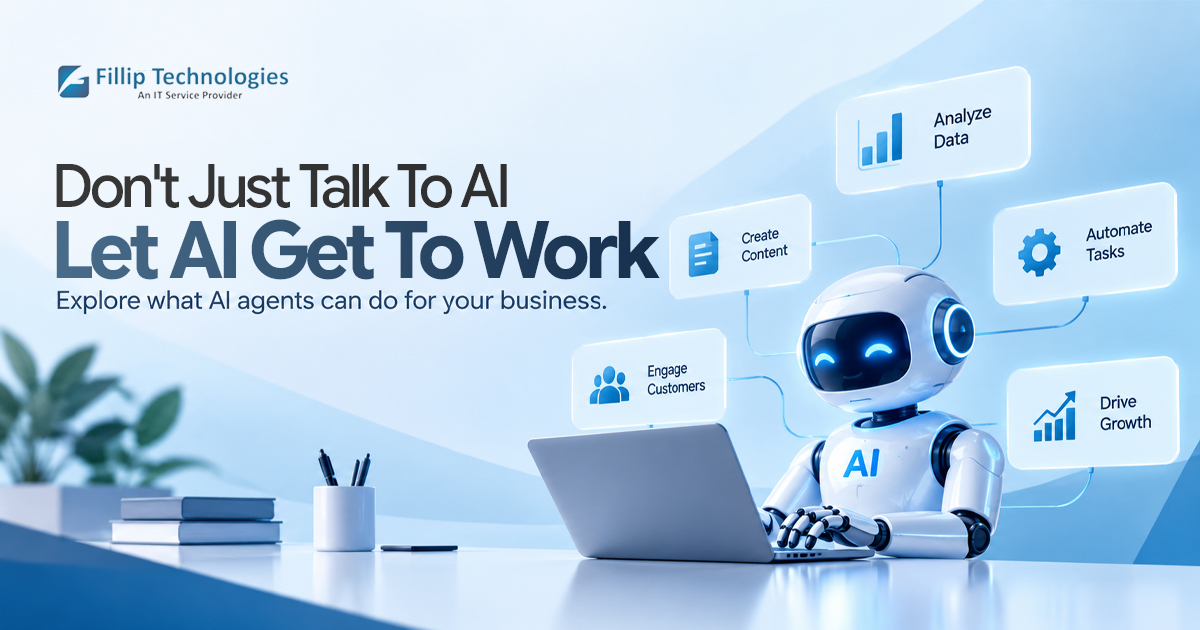
Beyond just answering questions, creating content, and even composing emails, AI has come a long way. The next step is AI being able to accomplish tasks and take meaningful actions.
Imagine an AI that takes up a lead, recognizes what the customer requires, references your CRM database, qualifies the inquiry, sends out a customized response, schedules the meeting, updates the database, and alerts your sales team—all without requiring much manual intervention.
That is where AI agents for business can redefine the way organizations operate.
While chatbots have largely focused on responding to user inputs, AI agents can be designed to recognize intentions, make decisions, use tools, execute tasks, and adapt accordingly.
For businesses that want to reduce repetitive tasks, deliver better customer experiences, and create smarter workflows, AI agents could become more than just a technological upgrade.
What Are AI Agents?
AI agents are intelligent software systems designed to operate with the aim of achieving specific goals.
Unlike traditional systems that simply provide an answer when a question is asked, AI agents can take additional steps to complete a task.
Understand → Plan → Act → Observe → Adapt
Suppose a company receives numerous inquiries every day. A conventional chatbot might respond with:
"You have reached us. How can we assist you?"
An AI agent can do much more. It understands the inquiry, identifies the client's needs, searches for relevant information, qualifies the lead, captures the necessary data, updates the CRM, responds appropriately, and follows up when required.
This ability to move beyond conversations and execute tasks makes AI agents particularly valuable for businesses.
AI Agents vs. Conventional Chatbots
One of the simplest ways to understand AI agents is to compare them with conventional chatbots.
A conventional chatbot typically follows predefined conversations or responds to specific questions. An AI agent, on the other hand, is given an objective and can determine the steps needed to achieve it within its configured permissions.
Example: Chatbot vs. AI Agent
Chatbot:
"This is what we offer."
AI Agent:
"I understand that you are looking for website development. I have recorded your requirements, gathered the relevant service information, and scheduled an appointment for tomorrow morning at 11 o'clock."
A chatbot primarily provides information, while an AI agent can help move a business process forward by taking authorized actions.
This is why many companies are exploring AI agents not only for customer support but also for sales, operations, administration, and other business functions.
Real-World Applications of AI Agents for Business
AI agents can be used across multiple departments and business functions. Their potential becomes especially valuable when organizations identify processes that involve repetitive steps, information gathering, or routine decisions.
1. Lead Qualification and Sales Follow-Up
Not every inquiry has the same level of urgency or business potential. Sales teams often spend considerable time processing inquiries, asking qualifying questions, entering records into CRM systems, and following up with potential customers.
An AI sales agent can help streamline this process by performing tasks such as:
- Capturing incoming leads from different channels.
- Asking relevant lead qualification questions.
- Understanding customer requirements and preferences.
- Categorizing leads according to predefined criteria.
- Entering lead information into the CRM database.
- Sending personalized follow-up emails or messages.
- Scheduling sales appointments based on availability.
- Alerting sales representatives when human interaction is required.
By automating routine sales activities, businesses can help their sales teams focus more on meaningful conversations and closing opportunities.
2. Customer Service That Goes Beyond FAQs
Customer service is one of the most common applications of AI, but its potential extends far beyond answering frequently asked questions.
An AI-powered service agent can understand a customer's problem, retrieve relevant information, access authorized order or service details, initiate a workflow, and escalate complicated cases to a human representative.
For example:
"My order hasn't been delivered."
Instead of simply displaying a shipping tracking page, the AI agent could retrieve the order details, check the delivery status, identify potential delays, explain the situation, and initiate the appropriate next step.
The objective is not necessarily to replace customer service employees. It is to reduce routine work and help teams resolve customer issues more efficiently.
3. Appointment Scheduling
Managing appointments manually can consume valuable time. Businesses that depend on consultations, bookings, and scheduled services can use AI agents to simplify the process.
Examples of businesses that may benefit include:
- Healthcare providers
- Consultants
- Hotels
- Service companies
- Salons
- Marketing and technology agencies
- Professional service firms
An AI scheduling agent can:
- Understand appointment requests.
- Check calendar availability.
- Offer suitable time slots.
- Confirm bookings.
- Send appointment reminders.
- Reschedule appointments when needed.
- Update connected calendars.
- Notify the appropriate team members.
Instead of employees coordinating multiple messages, calendars, and spreadsheets manually, an AI agent can manage much of the scheduling workflow according to business rules.
4. AI Agents for Business Research
Business research often involves gathering information from multiple sources, organizing findings, comparing results, and drawing conclusions. AI research agents can help make these activities faster and more organized.
Common applications include:
- Market research
- Competitor analysis
- Customer research
- Industry trend analysis
- Research summaries and report generation
For example, when a company plans to enter a new market, an AI research agent can collect relevant information, analyze findings, identify potential trends, and prepare an initial research report for the strategy team.
Human experts can then validate the findings, evaluate the context, and make final strategic decisions.
The result is a practical combination: AI for speed and humans for judgment.
5. Marketing Workflow Automation
Marketing departments handle many repetitive activities, including content research, campaign analysis, audience segmentation, performance reporting, and follow-up coordination.
AI agents can assist with:
- Content research and topic discovery.
- Marketing campaign analysis.
- Audience segmentation.
- Personalized communication.
- Campaign performance monitoring.
- Marketing report generation.
- Follow-up task management.
- Marketing workflow coordination.
When a business manages multiple campaigns simultaneously, AI agents can connect different marketing activities into a more coordinated workflow. Any changes to campaigns or budgets should remain subject to appropriate approval rules.
6. Finance and Administrative Tasks
Finance departments work with large volumes of structured data and recurring processes. AI agents can help automate parts of these workflows while keeping sensitive decisions under appropriate human oversight.
Potential applications include:
- Invoice data extraction and processing.
- Expense classification.
- Payment reminders.
- Financial report preparation.
- Data reconciliation support.
- Document processing.
- Responses to routine internal finance questions.
AI agents can handle repetitive first-level tasks, while finance professionals review exceptions, verify important information, and make financial decisions.
7. Internal Employee Assistants
AI agents do not have to interact directly with customers. They can also work as internal assistants that help employees find information and coordinate their work.
Imagine an employee asking, "How is this project going?" Instead of manually searching emails, documents, project management tools, and communication channels, an internal AI agent could retrieve authorized project information and prepare a consolidated update.
Internal AI agents can support:
- HR-related questions.
- Company policies and procedures.
- IT support and troubleshooting.
- Knowledge management.
- Meeting summaries and notes.
- Task coordination.
- Information retrieval.
- Employee onboarding.
By making scattered business information easier to access, internal AI agents can help employees work more efficiently.
8. Connecting Different Business Applications
One of the most valuable applications of AI agents for business is their ability to connect applications that would otherwise operate independently.
A typical business may use several tools, including:
- Website and web forms
- CRM software
- Email platforms
- WhatsApp and messaging tools
- Calendars and scheduling systems
- Accounting software
- Project management applications
The challenge is not necessarily the individual tools themselves, but the gaps between them. When systems are disconnected, employees may need to transfer information manually, repeat tasks, and manage separate workflows.
AI agents can act as an intelligent coordination layer, transferring information between connected applications and initiating actions according to business rules, available context, and assigned permissions.
The Future of AI Agents in Business
The future is not necessarily about businesses choosing between people and AI. It is about building workflows in which both work together.
AI agents can take responsibility for repetitive execution, information processing, coordination, and selected routine decisions. People can then devote more attention to strategy, creativity, relationship building, leadership, complex problem-solving, and decisions that require human judgment.
This collaboration is where much of the value of AI agents in business can emerge.
The most successful companies will not necessarily be those that use AI everywhere. They will be the ones that apply AI thoughtfully to the business processes where it can deliver meaningful results.
Transform AI From a Tool Into Your Business Advantage
AI agents introduce a new dimension to business automation. The important question is no longer simply:
"Is AI capable of answering this?"
The more useful question is:
"Can AI help us accomplish this?"
Across sales, customer support, research, marketing, finance, scheduling, and operations, AI agents can transform individual tasks into coordinated, intelligent workflows.
At Fillip Technologies, we do not build AI simply because it is trending. We analyze business challenges, identify suitable opportunities for automation, connect the right tools, and develop solutions aligned with real business objectives.
Our approach focuses on practical AI automation that helps businesses streamline operations, improve workflows, and make better use of their existing technology.
The future of business automation is not just about smarter conversations; it is about smarter action.