

Over time, businesses have played the game of SEO with one objective in mind: to rank high on Google, get clicks, and convert those visits into sales.
But search has evolved.
Now, a prospective client may not go to Google and type in “best digital marketing company in Patna” before looking at 10 blue links. Instead, he/she might pose a very conversational query to an AI-based search engine:
“Which digital marketing company in Patna can help a small business increase its online presence?”
Rather than merely providing a list of pages, AI-based search experiences would be able to synthesize content from various sources and give an answer backed by links and citations.
This leads to another question: What if a customer searches for your business, but not on Google’s regular search results page?
And that is where Generative Engine Optimization (GEO) comes in.
Google has been building out AI-based experiences on Search through features such as AI Overviews and AI Mode, and in June 2026, it launched a new Search Console reporting tool for visibility inside the generative AI experience for a certain number of websites.
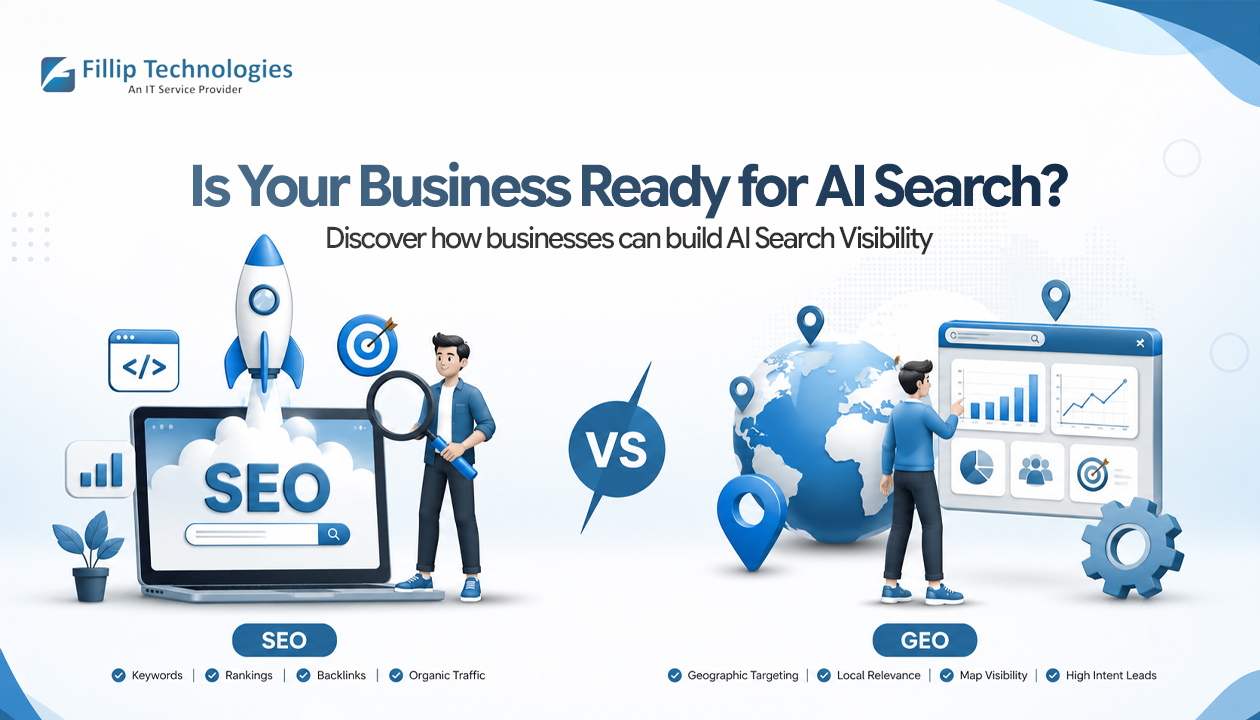
The future of search is not SEO vs GEO. SEO will become much more than that.
What Is Generative Engine Optimization (GEO)?
Generative Engine Optimization (GEO) means structuring your content in such a way that your website is easier to find, interpret, and possibly be quoted by AI search and answer engines in their response generation process.
Standard SEO usually revolves around making web pages visible and competitive in search results. While GEO includes an additional element: Is the content understandable enough for an AI system to use it as a source while providing an answer to the user?
The importance of the difference lies in the fact that AI searches have a different approach compared to traditional searches.
For example, a user may ask:
Traditional search:
“SEO company in Patna”
AI search:
“What should a local business look for when choosing an SEO company in Patna?”
The second query will be more conversational and intent-based. Which means that the content you need to create cannot be merely keyword-focused anymore.
SEO Is Not Dead. It Is Gaining Importance.
The major misconception about GEO is that organizations need to stop their SEO efforts. This isn't the case.
As far as Google's recommendations about the use of AI in search go, they point out that many of the principles of Search remain as important now as before: original and helpful content, good page experience, crawlability, indexability, and structured data that is correct in terms of the actual content.
In other words:
GEO does not substitute SEO; it enhances strong SEO practices.
The logic goes like this:
SEO → Makes search engines aware of your content and ranks it.
GEO → Enables AI to comprehend and possibly use your content when generating answers.
Strong digital authority → Provides both with additional reasons to trust your brand.
Such an approach becomes ever more relevant for companies implementing their digital marketing strategy in 2026.
Why Is GEO Important for Businesses in 2026?
Consider two companies providing the same service:
Company A has an online presence characterized by generic service pages, keyword stuffing, and thin content on blogs.
Company B creates detailed how-to guides, responds to user queries, showcases its competence and knowledge about its processes, shares insightful content, keeps all its business data accurate and up to date, and gains authority through consistent efforts.
Which business provides more information to the AI when trying to understand the industry?
Company B does.
That is the basic idea of GEO.
In its guidelines, Google emphasizes the necessity for websites to produce unique content focused on user needs rather than generic content. Moreover, the company advises creating technologically accessible websites that have structured data corresponding to their actual content.
For businesses, AI visibility begins with usefulness.
Seven Ways to Get Ready for GEO in Your Business
1. Write Actual Answering Content
Stop writing 1,500-word articles just to target keywords. Create them because there is a question to be answered.
Instead of:
“SEO Services – Best SEO Company – SEO Agency”
Create content in response to:
"How does local SEO benefit small businesses?"
"How much time will it take to see the results from SEO?"
"What are the characteristics of SEO-friendly websites?"
"How do companies show up in AI search results?"
"How is SEO different from GEO?"
In this way, you capture all three elements of the SERP.
2. Provide Evidence, Not Statements
E-E-A-T – Experience, Expertise, Authoritativeness, and Trustworthiness – becomes especially important when creating content that will be used to form answers to questions by an AI system.
Don’t just claim:
"We are experts in digital marketing. "Prove it by providing:
Case studies
Examples
Observations
Research
Expert views
Processes
Outcomes (if applicable)
Credentials of the author
Recommendations
Being authoritative doesn't mean saying you are one.
3. Create Topical Authority
A single standalone piece cannot build authority. What if you offer SEO services to your business?
Create a topic-specific content network rather than writing a single piece on SEO like this:
SEO → Local SEO → Technical SEO → On-Page SEO → Content Strategy → Google Business Profile → AI Search → GEO → Analytics → Conversion Optimization
This approach will help to cover the topic in greater depth and will allow search algorithms to understand what exactly you know.
For instance, creating content on local SEO, optimizing Google Business Profile, social media marketing, paid advertising, website development, and AI-driven marketing may be helpful to boost a brand's topical footprint.
4. Make the Text Easy for AI and Readers to Comprehend
It is important that AI should be able to make sense of your content; however, humans should also like to read it. The structure is of paramount importance here.
Use the following elements:
Explicit headings
Short paragraphs
A straightforward answer
Relevant examples
Definitions
Comparisons
Statistical data with sources
Step-by-step instructions
Descriptive titles
Internal links
Do not hide your key points under five introductory paragraphs. Answer first. Elaborate further. Provide support.
5. Enhance the Digital Presence of Your Brand
A brand is not only represented by its website. AI-powered search algorithms could come across information about any business in various places on the web.
That’s why a strong digital footprint becomes more relevant than ever.
Consider:
Website + Google My Business Listing + Social Media + Industry-Specific Platforms + Review Sites + PR Activity + Authorship Pages + Brand Mentions + Valuable Content Pieces
It’s not about creating mentions everywhere. It’s about building a believable, consistent, and recognisable online identity.
Remember: GEO technology is constantly changing. Recent studies prove that visibility through AI systems can differ considerably depending on systems and searches conducted, so there is no reliable “GEO trick” that guarantees citation forever.
6. Do Not Forget About Technical SEO
Even if you write brilliant content, it won’t be found by search engines if it cannot be reached.
Google recommends that businesses ensure that pages are crawlable, indexable, and technically accessible. Also, it recommends checking that structured data matches content on pages.
Thus, businesses must keep on doing investments into:
Website Speed
Mobile Optimisation
Technical SEO
Crawling
Indexing
Internal Link Building
Structured Data
Secure Website Architecture
Clear URL structures
Moreover, website design and development become part of the extensive search strategy, not apart from it.
7. Measuring Visibility Beyond Rankings
For many years, marketers were asking the question: “What ranking does my website occupy?”
The question is important. But it’s not the only question to be considered anymore. In addition, businesses will more and more start to ask:
“Are we showing up in AI-driven answers?”
“Is our brand getting mentions?”
“Are our pages getting citations?”
“Which questions are making us visible?”
“Who are our competitors that show up?”
“Do we get conversions from AI-driven traffic?”
“Do branded searches go up?”
“Is our content attracting quality users?”
In particular, Google’s 2026 Search Console update is interesting since it includes reporting specifically for visibility in generative AI features like AI Overviews and AI Mode, but it’s currently being rolled out only to some websites.
Visibility has become different, which is why the whole measurement space has changed.
The Future of Search Is Going to Those Who Become the Answer
Search has evolved from "Where can I find the information?" to "Show me the best answer."
It doesn’t mean websites become unimportant. It means the significance of expertise, authority, quality, and trust is growing even more.
If a company wants to thrive in this age of search, it needs much more than relevant keywords and backlinks. A company should have an advanced digital ecosystem that can show:
Who the company is.
What its knowledge is.
What services the company provides.
Why customers need to trust the company.
Why the company's information must be included in the answer.
Fillip Technologies believes that the future of digital growth lies in the intersection of human expertise and intelligent technologies. From SEO and digital marketing to website design, software development, AI-powered solutions, and business automation, the goal is not just visibility of the business.
The goal is to make it valuable, discoverable, and credible.
The future question is not "Can customers find your website?"
But it is "Will your business become a part of AI’s answer in your industry?"
Blog
From SEO to GEO: How Businesses Can Get Found in AI Search Results
Over time, businesses have played the game of SEO with one objective in mind: to rank high on Google, get clicks, and convert those visits into sales. But search has...
October 3, 2026Fillip Technologies1 min
Related Blogs
Keep Reading
Fillip Technologies
BlogWhat are the 7 types of AI? Understand with Example
As you are all likely aware, AI has emerged as the defining trend of 2026; whether it involves content creation or video generation, AI has truly dominated in every...
Read MoreJune 25, 20266 min
Fillip Technologies
Blog5 High-Paying Careers After Digital Marketing Training in 2026
Are you still aware of digital marketing? Hey, it is very important to be aware of digital marketing in 2026. Today, every business across India and worldwide goes...
Read MoreJune 13, 20266 min
Fillip Technologies
BlogUI UX Design Certification: Your Fast Track to a High-Paying UX Career
Ready to get praise in the corporate industry by solving real problems, crafting digital experiences that millions of people use. Plus, imagine waking up every...
Read MoreJune 12, 20267 min